




ORGANS OF PARIS © 2026 Vincent Hildebrandt HOME ALL ORGANS
Saint-Ignace
33 rue de Sèvres, 75006 Paris




Saint Ignace.
Tucked away on Rue de Sèvres in the 6th
arrondissement, you really need to know the
place to find it without hesitation. The entrance is
through the lobby of a modern building that
gives no hint of the vast nave beyond.
The Jesuits built this church between 1855 and
1858, funded by generous donors including
Napoleon III. It follows the neo-Gothic trend of
the time, much like the nearby Sainte-Clotilde
church then under construction. But its layout
reflects Jesuit architecture: a single nave to make
preaching easier.
During the dark days of the Commune, the
Jesuits had to scatter, the church closed, and it
was rented to a piano dealer (could've been
worse!). It stayed shut for 22 years. Not until
1923 was it restored and became the "church for
foreigners" before taking the name Saint-Ignace
in 1961.
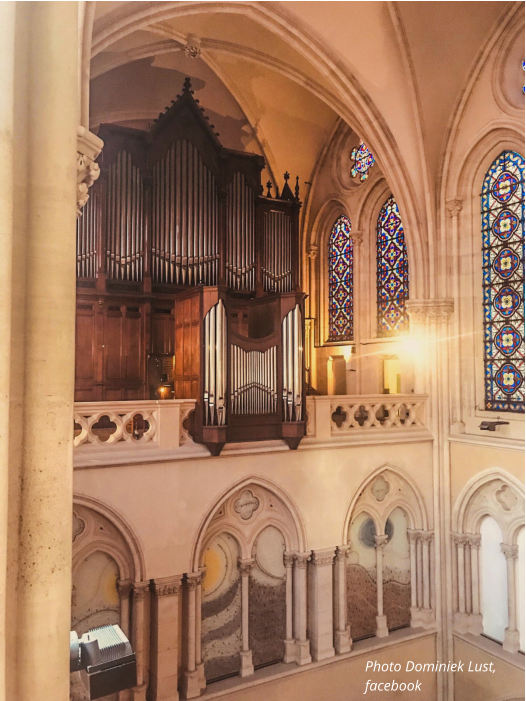
In 2017, the church got a full renovation. To bring
life to the 52 blind windows in the triforium
(blocked by surrounding apartments) Patrick
Rimoux designed light glass panels based on
texts by Saint Ignatius. They're made of
calligraphed, painted, and sandblasted glass
sheets, lit by LEDs whose color and intensity
adjust to the ambient light, adding warmth to the
very spare decor.
Texte : Thierry Correard

E5
1862
The instrument was originally built by the Belgian builder
Hippolyte Loret and was inaugurated by César Franck in 1862.
1891
But the organ gave no satisfaction, so, the Jesuits asked Cavaillé-
Coll to build a new instrument of 31 stops, in the Loret case. The
work was completed in 1891.
1924
Following the expulsion of the Jesuits during the law of 1905 and
the disaffection of the church, Mutin was commissioned to
overhaul the instrument in 1924, without making any changes to
the instrument.
1947
During a new overhaul, Danniellot and Salmon replaced the
Salicional and the Cornet with a Nasard and a Tierce.
I
1977
Haerpfer-Ermann was commissioned to complete a complete
restoration with the addition of a back positive with 11 stops.
1998
Maintenance work was carried out by Yves Koenig in
collaboration with Philippe Emeriau. The organ was completely
dismantled and cleaned, the worn parts replaced. The
mechanics were reviewed. The keyboard, the Salicional, the
Cornet and all the pieces of Cavaillé-Coll were restored. At the
Positif, the Clairon was replaced by a Cromorne.
2012
Yves Koenig & Philippe Emeriau carried out new maintenance
work on the traction and installation of a combinator. The organ
was completely dismantled and dusted. But the main work was
to renew all the bellows of the instrument. Used and obsolete
stop draw reels were replaced.
2018
Yves Fossaert replaced all the conducts eaten away by oxidation.
Source
Pierre Queval speaks about the organ


1862 - Hippolyte Loret (buffet)
1891 - Cavaillé-Coll (1)
1924 - Mutin (6)
1947 - Daniellot & Salmon (6)
1977 - Haerpfer-Ermann (3a)
1998/2012 - Koenig & Emeriau (5)
2012 - Koenig & Emeriau (6)
2018 - Fossaert (6)
III/43 -
mechanical traction (manuals),
lectrical traction (stops)
Stoplist


Titular organist
Simon Cnockaert, Pascal Marsault, Anne-
Isabelle de Parcevaux et Pierre Queval.
Organistes célèbres ayants illustré l’instrument par
le passé : Jacques Berthier, Michel Bonfils, Père
Joseph Gelineau.
Parish website
Videos
Pierre Queval I
Pierre Queval II
Photos
Buffet : Jeroen de Haan
Console : Thierry Correard








The organs of Paris
Saint-Ignace
33 rue de Sèvres, 75006 Paris


ORGANS OF PARIS © 2026 Vincent Hildebrandt

E5
1862
The instrument was originally built by the Belgian builder
Hippolyte Loret and was inaugurated by César Franck in
1862.
1891
But the organ gave no satisfaction, so, the Jesuits asked
Cavaillé-Coll to build a new instrument of 31 stops, in the
Loret case. The work was completed in 1891.
1924
Following the expulsion of the Jesuits during the law of
1905 and the disaffection of the church, Mutin was
commissioned to overhaul the instrument in 1924, without
making any changes to the instrument.
1947
During a new overhaul, Danniellot and Salmon replaced
the Salicional and the Cornet with a Nasard and a Tierce.
I
1977
Haerpfer-Ermann was commissioned to complete a
complete restoration with the addition of a back positive
with 11 stops.
1998
Maintenance work was carried out by Yves Koenig in
collaboration with Philippe Emeriau. The organ was
completely dismantled and cleaned, the worn parts
replaced. The mechanics were reviewed. The keyboard, the
Salicional, the Cornet and all the pieces of Cavaillé-Coll
were restored. At the Positif, the Clairon was replaced by a
Cromorne.
2012
Yves Koenig & Philippe Emeriau carried out new
maintenance work on the traction and installation of a
combinator. The organ was completely dismantled and
dusted. But the main work was to renew all the bellows of
the instrument. Used and obsolete stop draw reels were
replaced.
2018
Yves Fossaert replaced all the conducts eaten away by
oxidation.
Source
Pierre Queval speaks about the organ
1862 - Hippolyte Loret (buffet)
1891 - Cavaillé-Coll (1)
1924 - Mutin (6)
1947 - Daniellot & Salmon (6)
1977 - Haerpfer-Ermann (3a)
1998/2012 - Koenig & Emeriau (5)
2012 - Koenig & Emeriau (6)
2018 - Fossaert (6)
III/43 -
mechanical traction (manuals),
lectrical traction (stops)
Stoplist

Titular organist
Simon Cnockaert, Pascal Marsault, Anne-Isabelle de
Parcevaux et Pierre Queval.
Organistes célèbres ayants illustré l’instrument par le passé :
Jacques Berthier, Michel Bonfils, Père Joseph Gelineau.
Parish website
Videos
Pierre Queval I
Pierre Queval II
Photos
Buffet : Jeroen de Haan
Console : Thierry Correard

